Four Native Bees
Adapted from a blog post by Cooper Forsman.
Photos by Cooper Forsman.
Our corner of Chicago's West Side has industrial roots, covered in asphalt and warehouses. The local-ecotype native plants at our shop stand out: not just to people, but also to insects moving through a landscape that offers them very little. The railroad right-of-way nearby has some of native wildflowers mixed in with the weeds, and we like to think of it as an artery, moving pollinators to and from the oasis of our yard in the same way the train tracks move people. In July and August, the bee traffic is particularly high.
Most people notice the honeybees first, but they are only part of the picture. Honeybees aren’t actually native to North America: they were brought here from Europe in the 1600s and function more like livestock than wildlife. They are not in any real danger of dying out (countless SAVE THE BEES campaigns with honeybee photos notwithstanding) and ecologically, they aren’t always heroes: where hive density is high, managed colonies can outcompete native bees. While honeybees are an important part of modern food systems (honey is hard to beat), the roughly 500 native bee species in Illinois are often overlooked in a world where native pollinator numbers are declining rapidly.
Luckily our native plants serve everyone, and four types of native bees were especially busy in the yard last month. What interests us is how differently each one depends on the plants: as food, as nursery material, and as housing in itself.
Brown-belted bumblebee — Bombus griseocollis
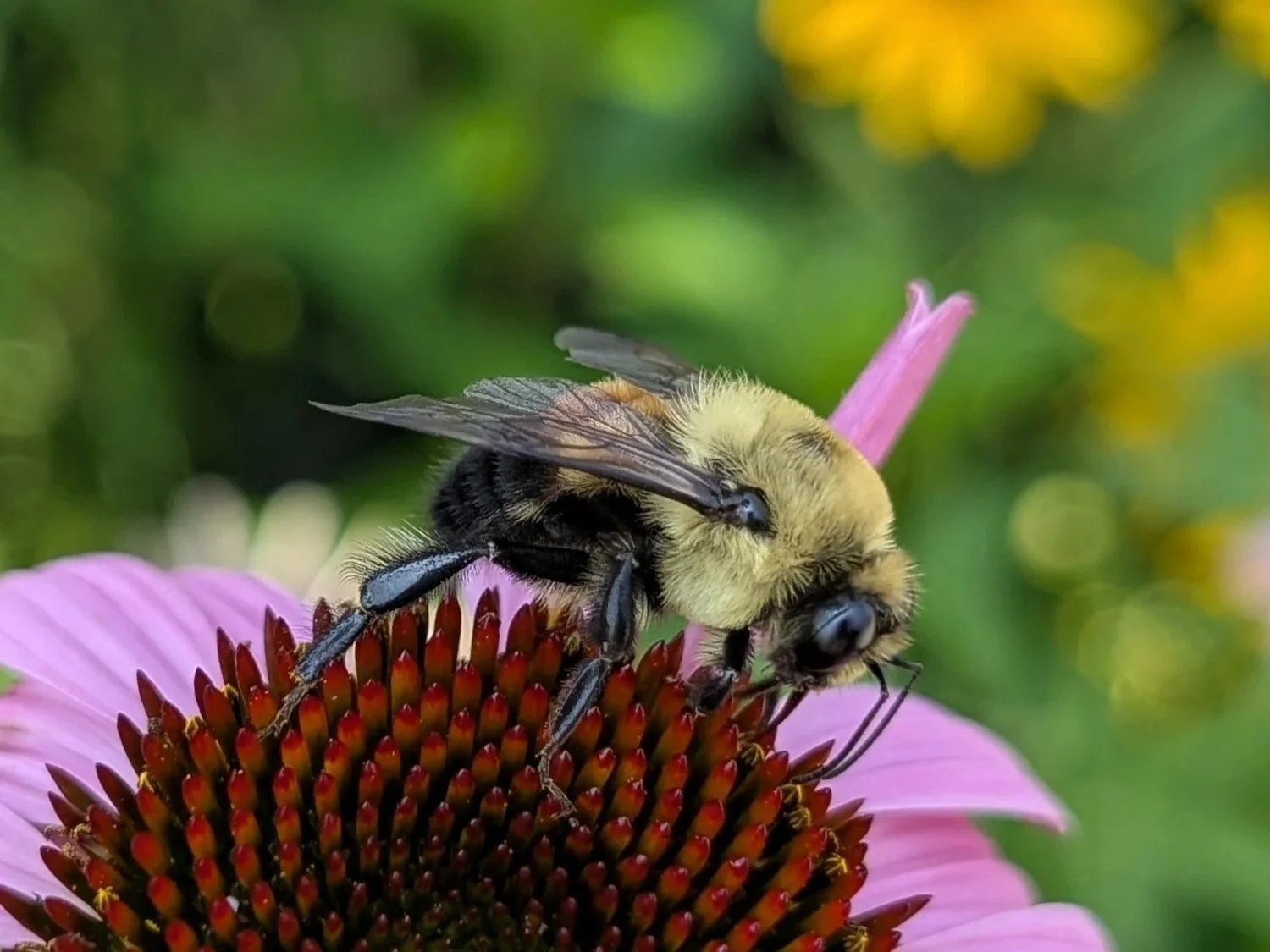
Like honeybees (and unlike many other native bees), bumblebees generally live in societies. A queen emerges from hibernation in spring, finds an abandoned rodent burrow or a dense clump of grass, and starts a colony that has to feed itself continuously until frost.
Unlike a honeybee hive, she can't stockpile. A bumblebee colony keeps only a few days of nectar on hand. That means blooms in April, blooms in September, and every month in between, all within a short flight of a hole in the ground that nobody has disturbed. A brown-belted bumblebee in July is evidence that spring blooms were there when she needed them.
Two-spotted longhorn bee — Melissodes bimaculatus
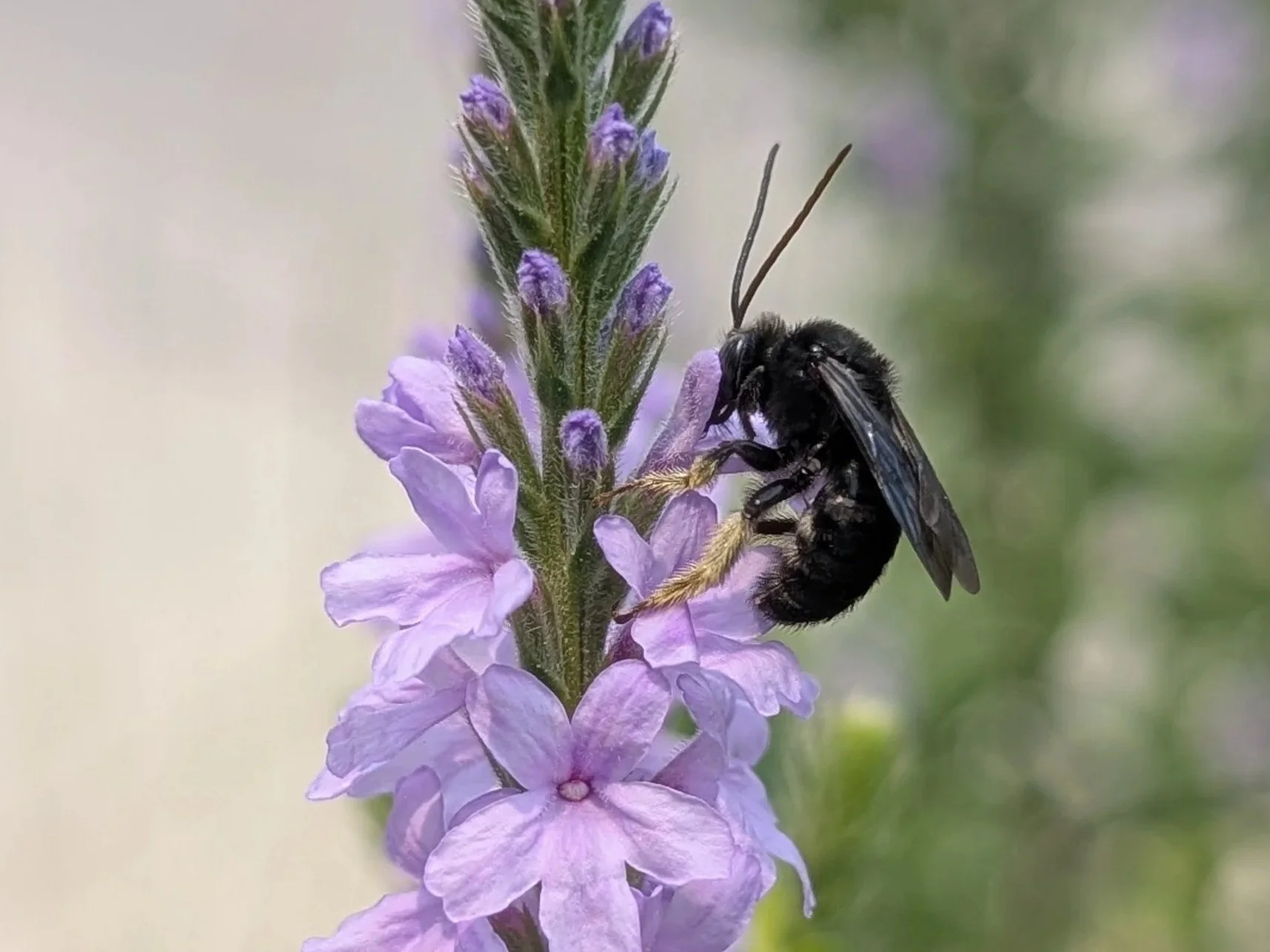
Most native bees are solitary, and the females operate as single mothers. Longhorns forage with an unshakeable focus that's hard to miss.
The stakes are high: longhorns have one generation per year, emerging in midsummer, with each mother digging and provisioning her own nest in the ground. If bloom timing slips out of alignment with her emergence, there's no second brood to make up the difference. The males (the ones with the long antennae that give the group its name) never return to the nest. At dusk, they clamp their jaws onto a flower stem and sleep there, sometimes several to a stalk.
Leafcutter bee — Megachile sp.
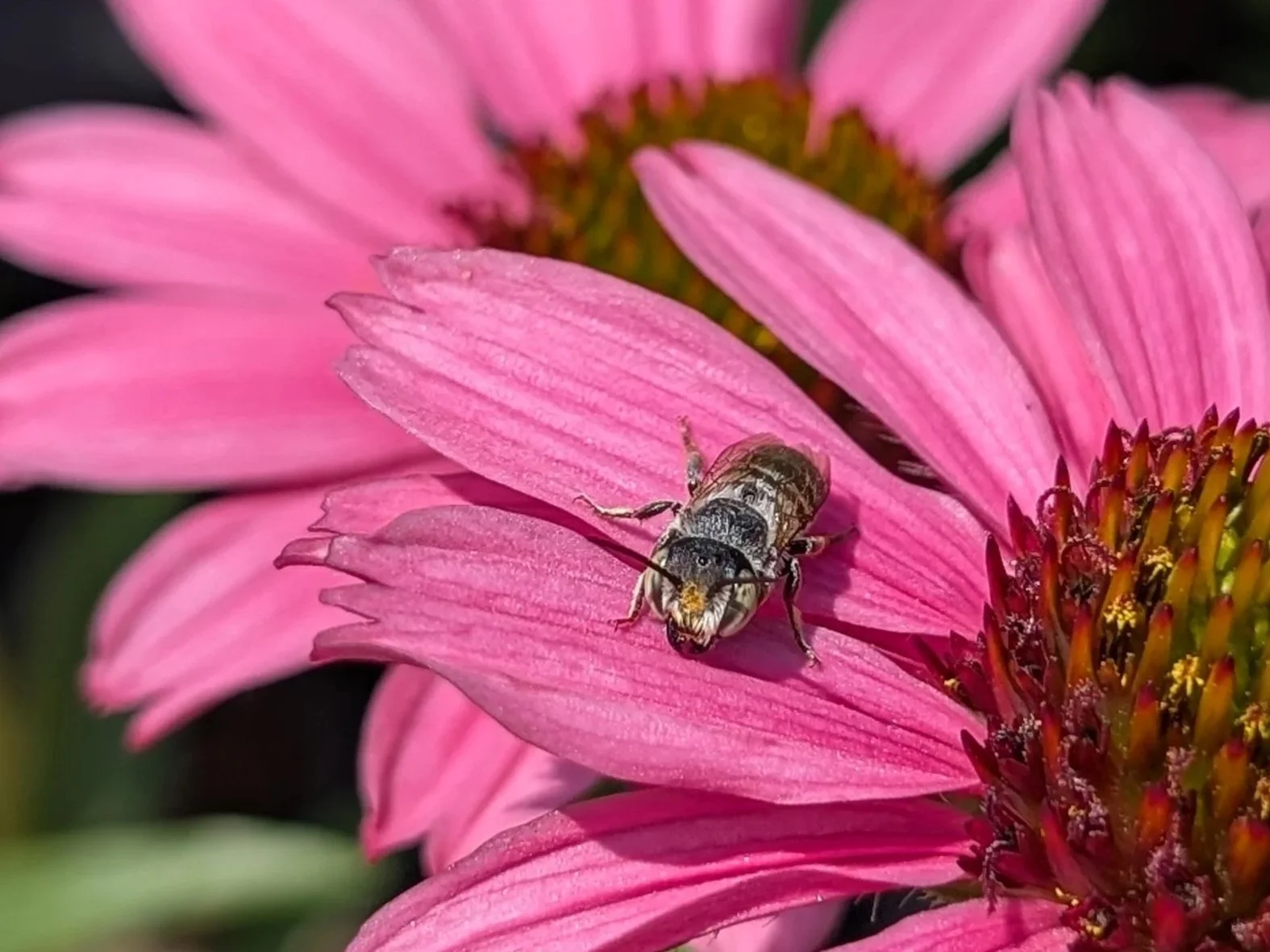
Leafcutters carry pollen on a brush of hairs under the abdomen, so you won't see their legs loaded with yellow like other bees. The females are builders, who cut neat discs of leaf tissue and use them to line the cells where her young develop. Redbud, ash, and roses are common sources, with round “chomps” taken out of the leaf edges.
Gardeners often see the circles as a sign of pests, but they actually indicate that the garden is being integrated into the living world. This also makes the question of avoiding pesticides with our native plants less abstract: these mothers are handling that leaf tissue directly and wrapping it around their offspring.
Masked bee — Hylaeus sp.
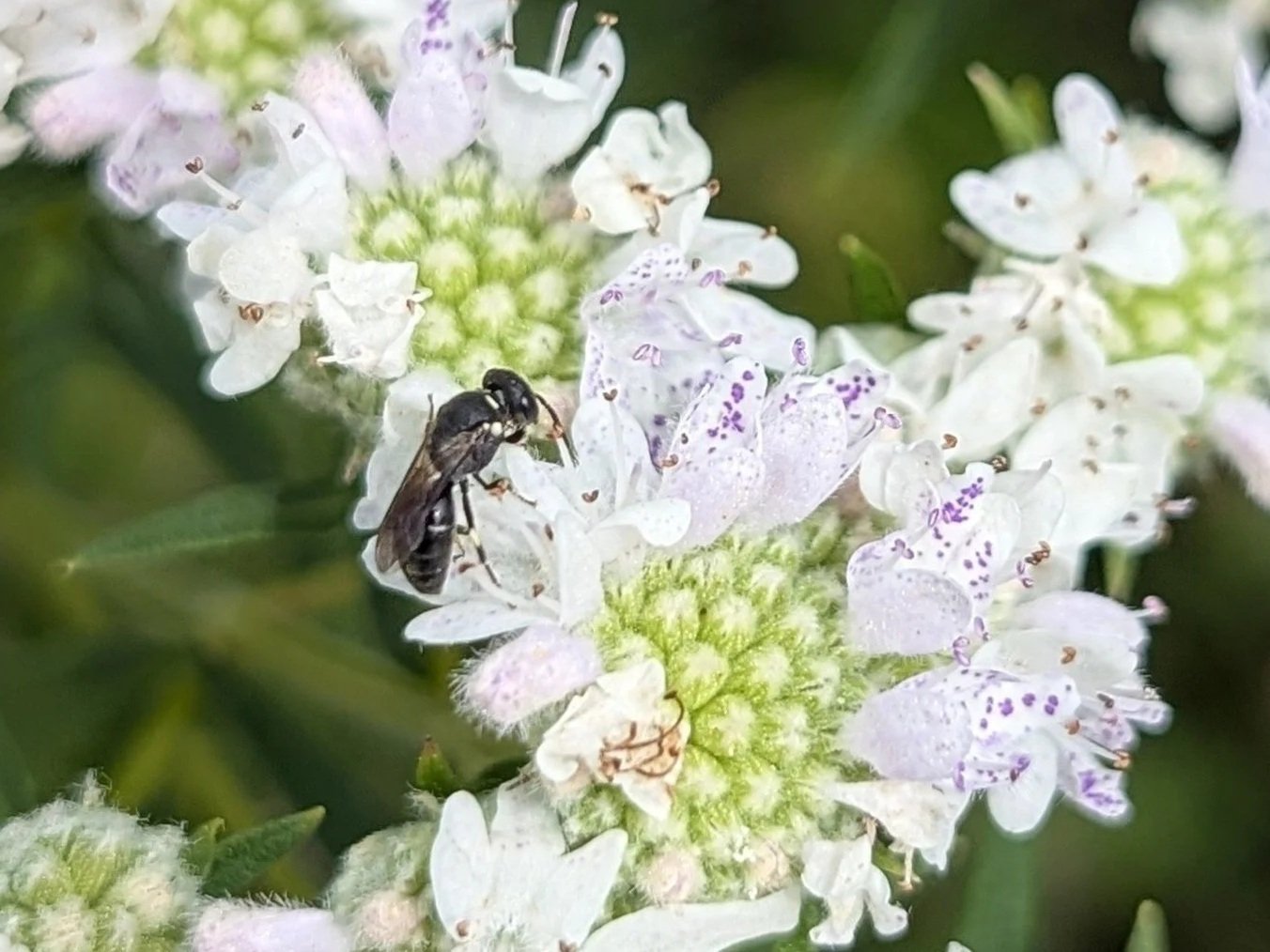
Six millimeters, nearly hairless, and so tiny and wasp-like that most people never register them as bees at all. A masked bee mother carries pollen internally: she swallows it, flies home, and brings it back up in the nest cell. She waterproofs the nest with a cellophane-like secretion she produces herself.
One thing she cannot manufacture is the cavity: she often nests in pithy stems (mountainmint, beebalm, and many others) where something else has already made an opening. If you want to help her out, cut your dead stems to about knee-high in winter and leave the stubble standing. She'll move in the following spring. Clearing that year-old stubble during spring cleanup is what breaks the cycle; let it decay on its own schedule.
What they ask of gardeners
Planting for "blooms all season" is good advice, but it isn't the whole picture. These bees need something closer to a functioning ecosystem: established plantings with real density, plus stems, sticks, and leaf litter available. Unfortunately, this runs against what we're taught a cared-for space looks like: aggressive spring cleanup, cutting everything to the ground in fall, a full redesign every few years because the planting looks tired… these are the patterns of constant disturbance that keep a planting from maturing into a community.
A bumblebee queen needs a nest left alone from October to April. A masked bee needs a standing stem waiting when she emerges. Neither are large requests, but both are measured in years, and require care and restraint. Three things worth doing this season, if you want to garden for these four:
Plant for bloom continuity, not peak. Plants blooming from April through hard frost. Ask us about where you might have bloom gaps!
Leave the stems. Knee-high cuts in late winter, stubble left standing through the following year.
Plant pithy-stemmed native plants. Cavity-nesters need somewhere to live, not just something to eat.
Relationships that took millions of years to build now hinge on ordinary decisions about how we garden. Come see these bees in our yard and let us help you give them the support they need!